The Glamping Brief Newsletter – Issue #09 – June 2026
In This Article
 Issue #09 — June 2026

to site.

Three years after the post-COVID glamping boom, the European market has changed profile. Operators who deployed fast with entry-level structures are now replacing them or regretting they can't. The demand signal is clear: 4-season performance, documented certifications, supply chains that hold up to a regulatory inspection. The bulk-catalogue-from-Asia model that worked in 2021 is producing problems in 2026.
This updated edition will cover more aspect because the gap between what suppliers propose and what operators actually need, has never been wider. I will try to share more technical insights to help navigate in it. In each edition: just straight to the points, and essentil data... Thierry Tombelle - Projects & Sourcing - +84 (0) 941 50 20 20
The global glamping market continues to expand: compound growth in the 8–10% range annually, driven by Europe and Asia-Pacific. The more relevant signal for operators and buyers: the growth is now concentrated in the premium and 4-season segments. Volume deployments are slowing. Replacement and upgrade cycles are accelerating.
For sourcing, this means the acceptable quality floor has risen. Structures quality that passed buyer expecttions in 2022 are not acceptable anymore in 2026. Suppliers who haven't upgraded their documentation, certifications, and production QC are losing contracts they used to win on price alone.
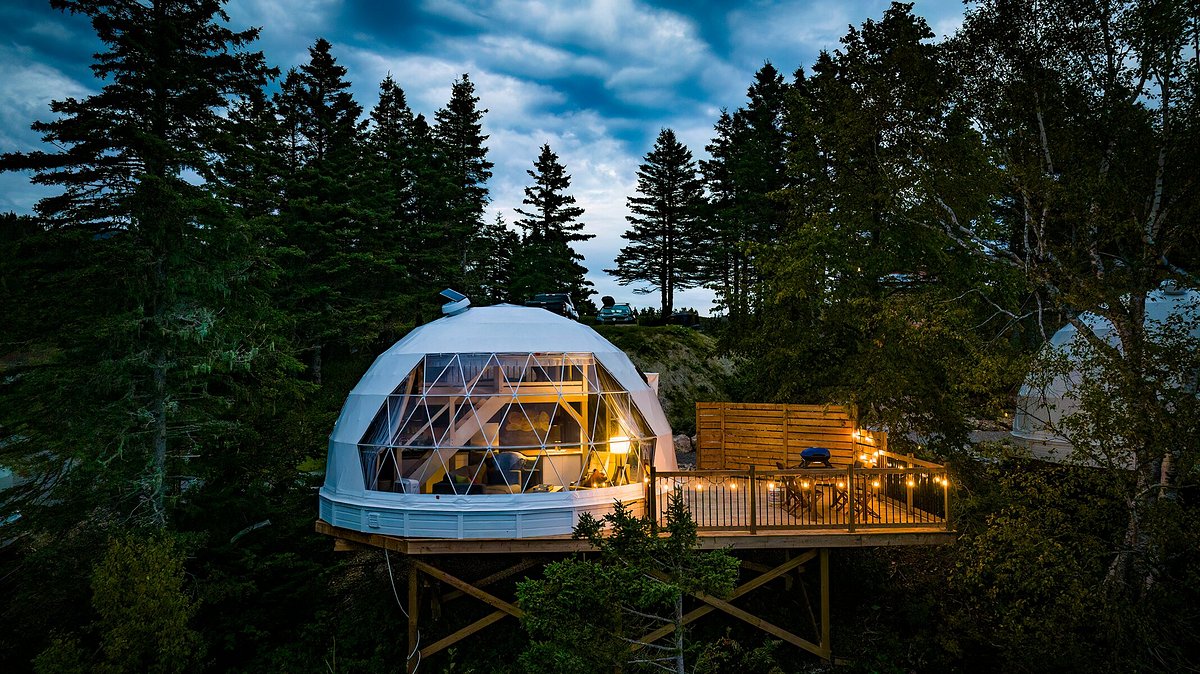
The 6m geodesic dome is the benchmark product for premium glamping. Sourcing challenge: the structural performance of a dome is entirely determined by two variables that most suppliers don't document: the strucural hub grade and PVC cover seams welded or stitched. Both are absent from most spec-sheets.
What to require in writing before any order: - Hub specification: galvanized steel tube (grade B-C), Diameter: 26mm (1") to 48mm (1.89") is the standard range. Wall Thickness: Minimum 1.2mm to 2.5mm. Thicker walls (2.5mm+) are required for domes exceeding 10 meters in diameter or those facing heavy snow loads.), - PVC cover: seam construction method (thermal weld only on load-bearing panels), High-quality covers typically range from 850g/m² for solid sections to 950g/m² for transparent windows. An SGS structural test report should specify the tested load conditions, not just the certificate number.
Most Asian suppliers advertise waterproofing with an HH rating — 1,500mm to 3,000mm. That number is measured on new fabric in lab conditions. After 12 months of UV exposure and seasonal storage, field performance drops significantly. How much depends on two factors that don't appear in catalogue listings: seam construction and UV treatment method.
Surface-sprayed UV treatment degrades within one season. Stitched seams wick moisture at the thread holes. Two questions to ask any supplier before ordering: "Are structural seams thermally welded?" and "Is UV protection integrated in the base coating or surface-applied?" The answer, or the absence of one, tells you what you need to know.
"A 3,000mm HH rating on a stitched, surface-sprayed tent is a marketing figure. An 1,800mm HH on a welded, base-coated structure is a professional specification. The difference is invisible in a catalogue and very visible after two seasons."
The same four errors appear repeatedly on first direct Asian orders: no pre-production sample validated before full production, price accepted without a written spec sheet, pre-shipment inspection dropped to save time, and EU customs requirements for FR-certified textiles underestimated. Each is recoverable alone.
Combined, the cost, in delays, rework, customs holds, or partial returns, typically exceeds the saving the direct order was supposed to generate. A quick review before signing a first purchase order is the highest-ROI step available to an operator going direct for the first time.
The limitation remains quality management: In China, where ISO processes are often built-in, small and mid-sized manufacturers require more active production monitoring.
Largest installed base in continental Europe. Regulatory pressure increasing: ERP classification, fire standards, structural permits. Operators upgrading from first-generation structures represent the primary active demand for qualified worldwide sourcing.
An operator in Switzerland planning 5 glamping pods for summer 2026 received three quotes from Asian suppliers via online sourcing platforms. Three products, three different spec sheets, no common reference point. Prices varied by 40%. No way to compare on a rational basis.
Proposed approach: establish a single reference specification sheet before engaging suppliers, hub grade, seam method, PVC grammage, certifications required, MOQ tolerance. Re-submit to all suppliers same brief. Eliminates incompatible products, forces specs compliance, and qualifies the right suppliers
Share this article